Open Window: If cows didn’t like mustard
28 Feb - 19 Jul 2026
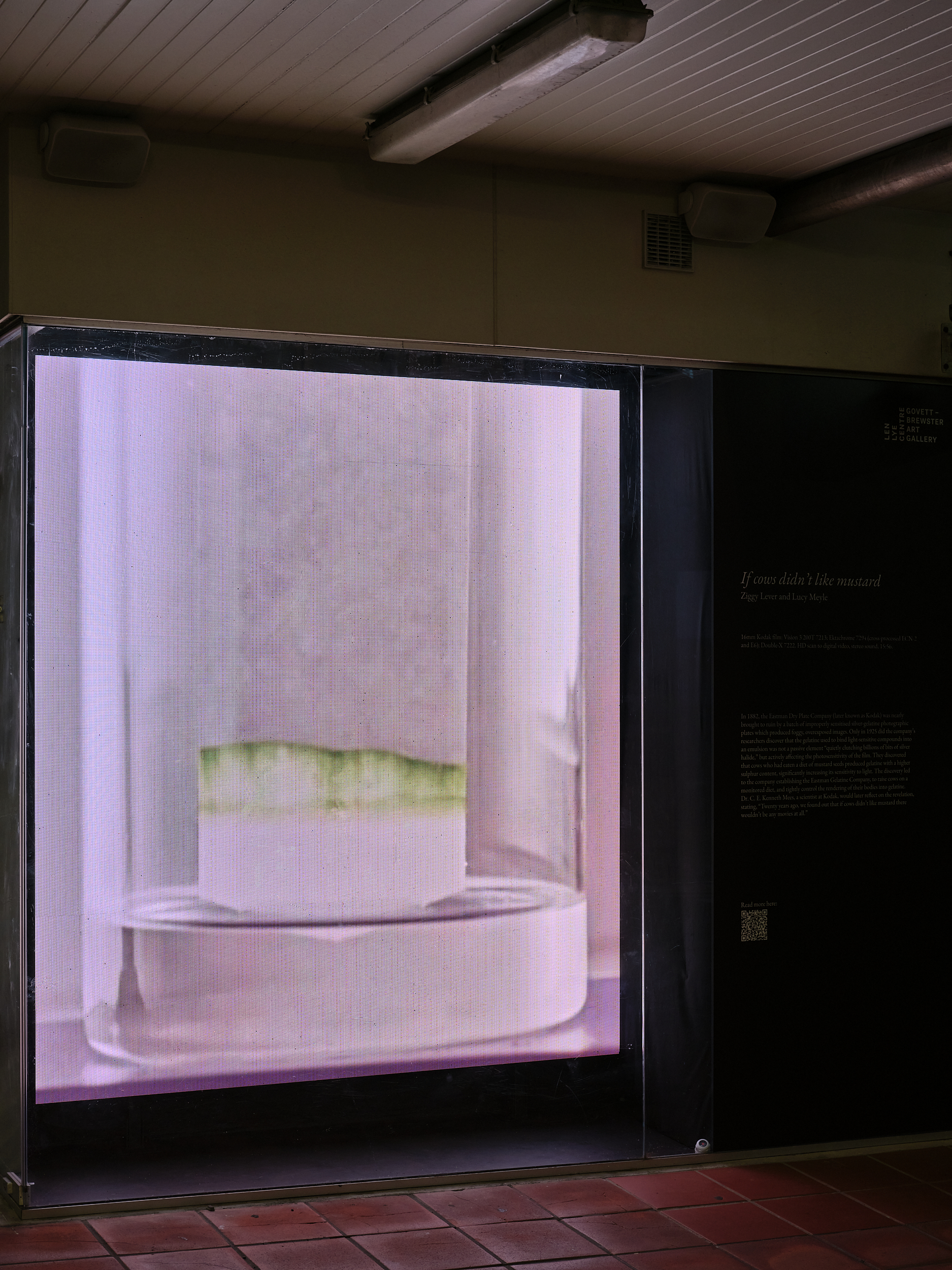
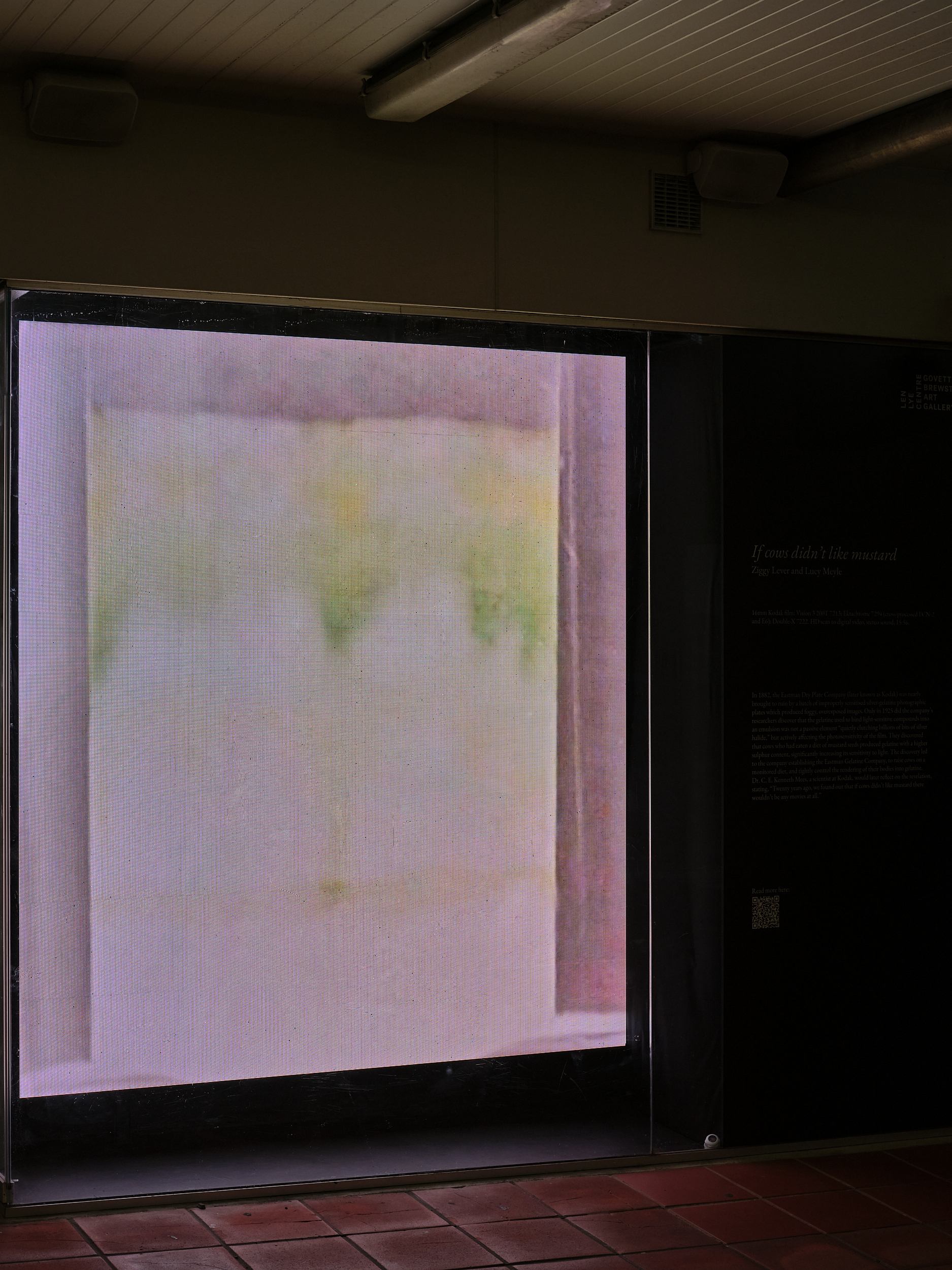
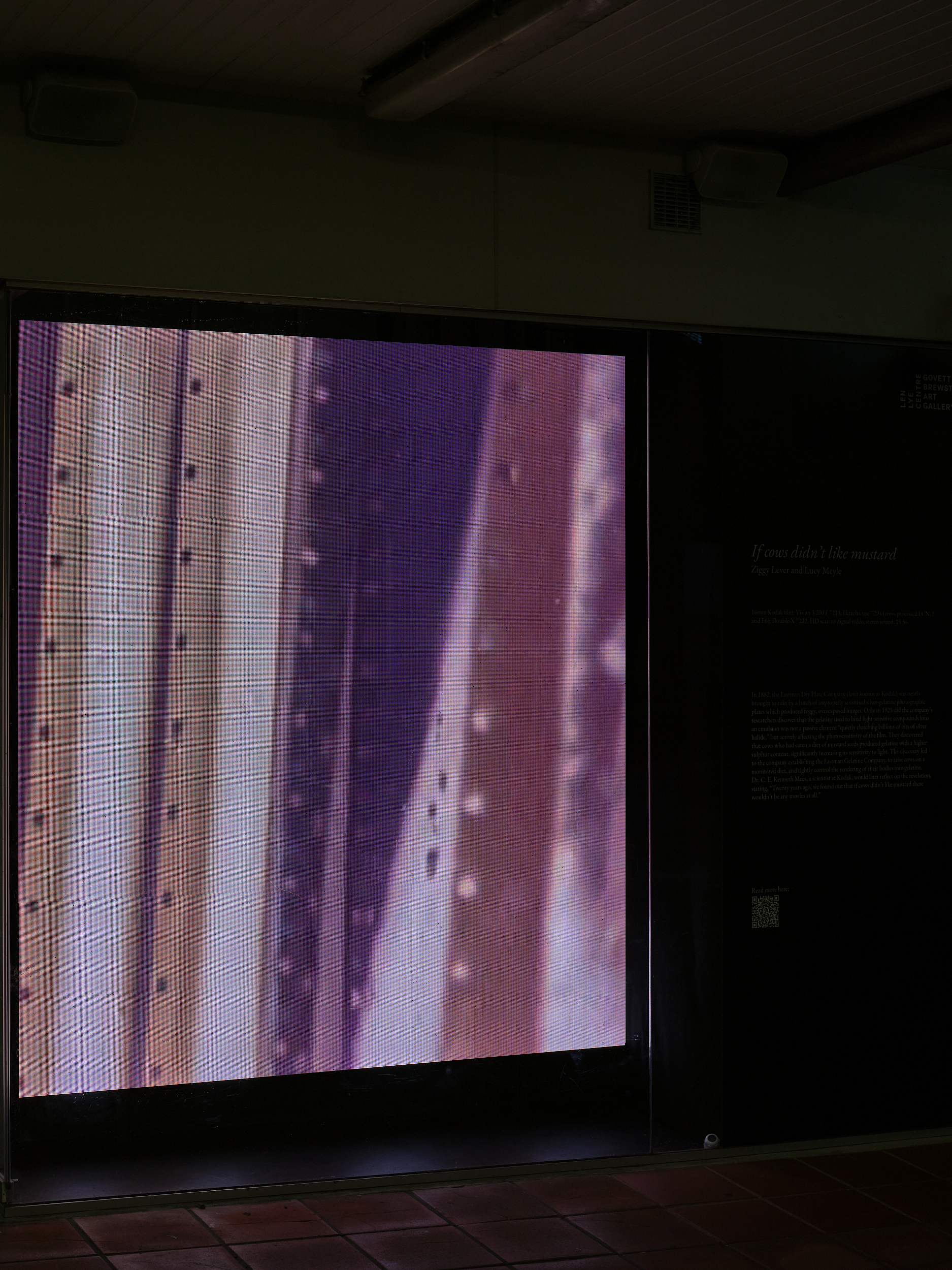
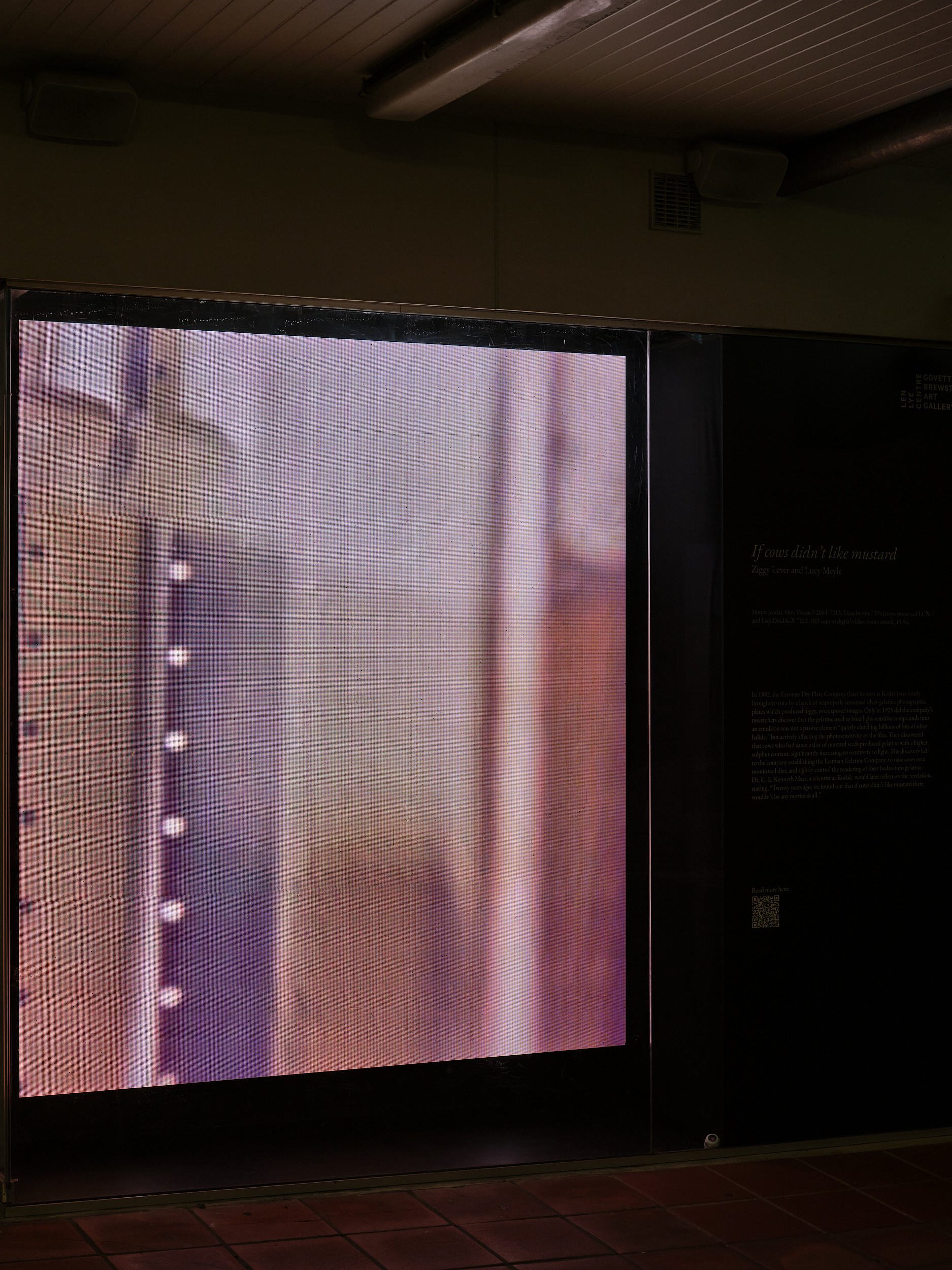
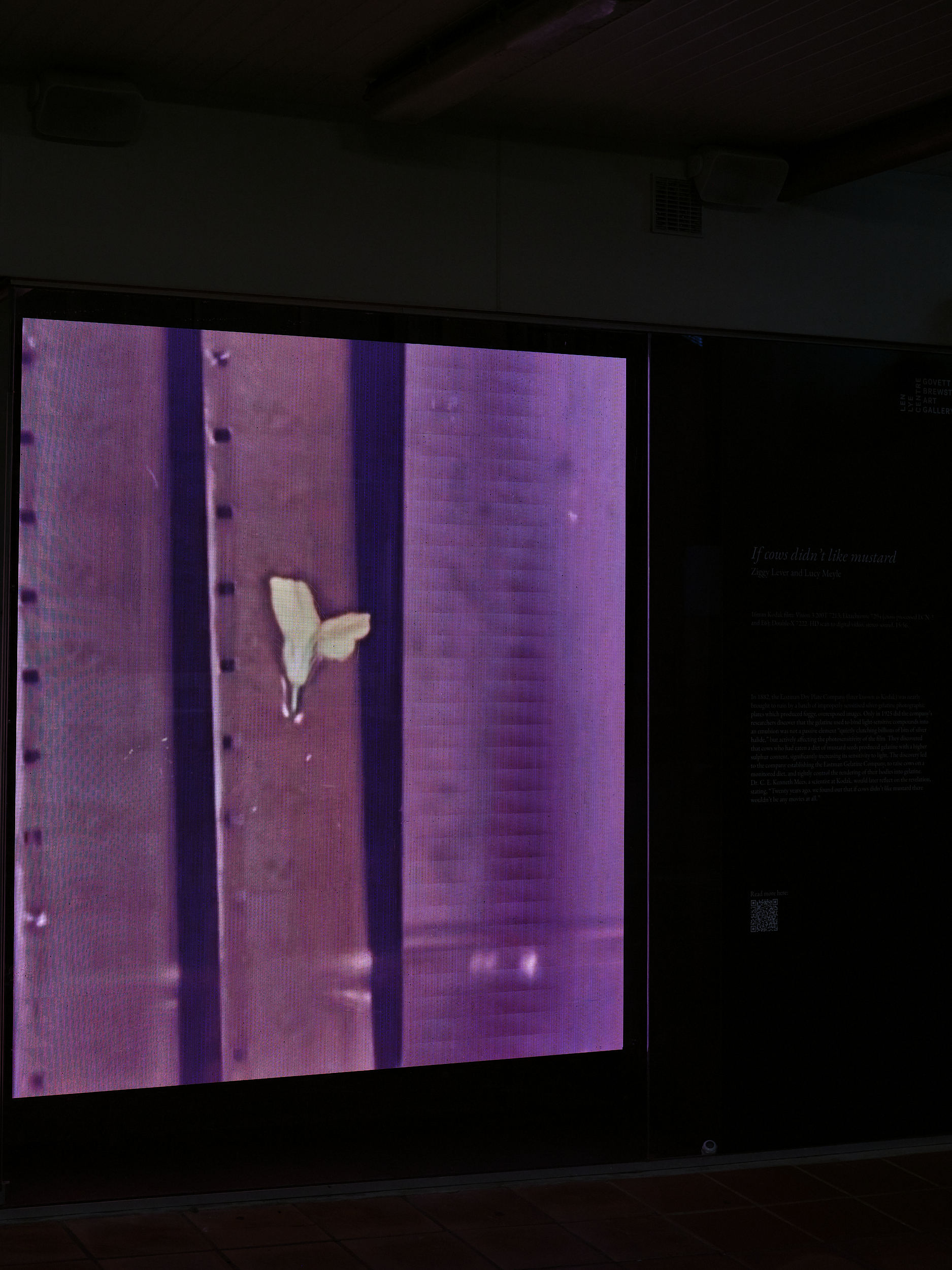
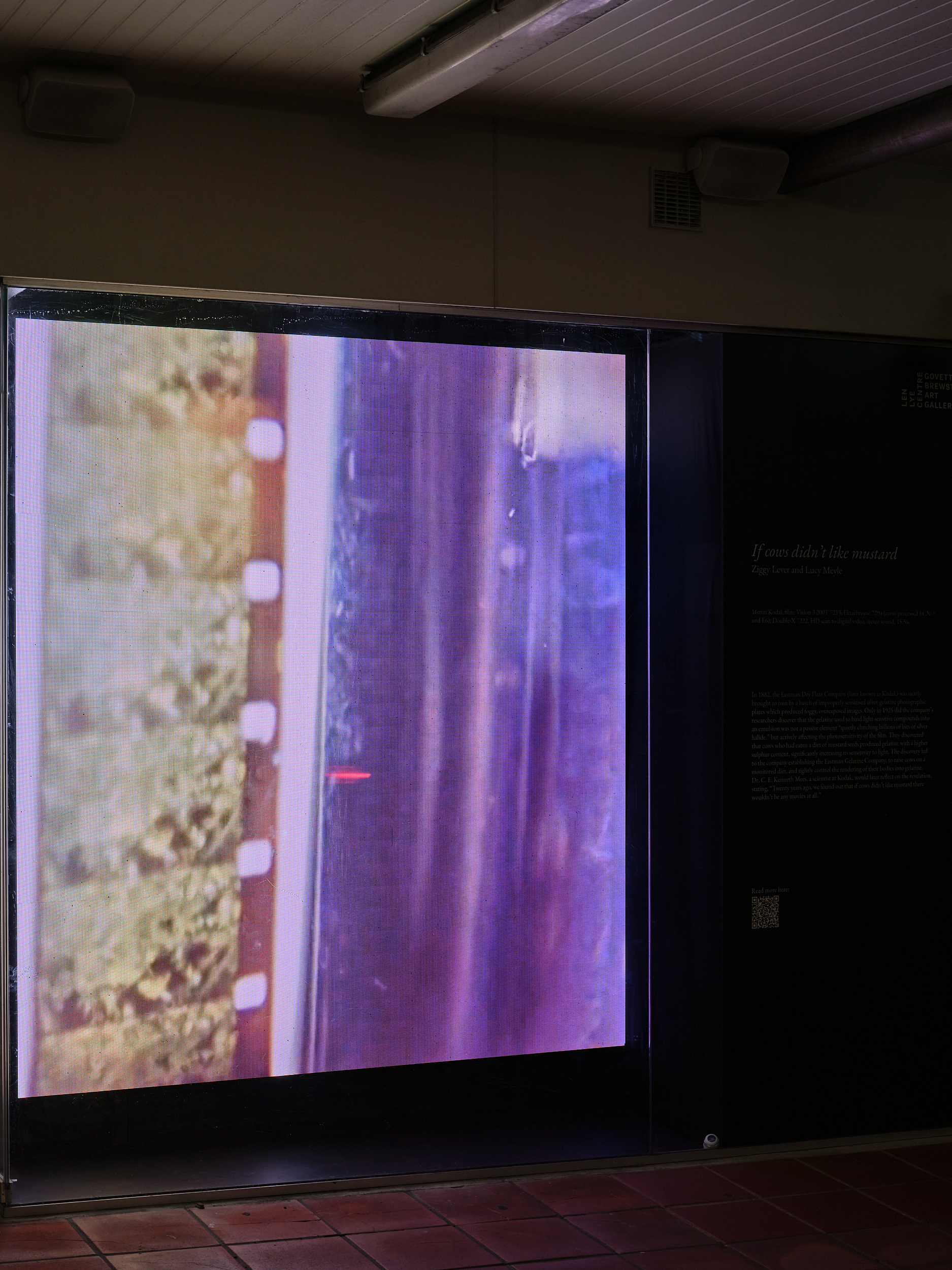
Ziggy Lever and Lucy Meyle’s newly commissioned moving image work considers the competing agency of humans, plants, animals and technology in the production of images and meaning.
The artists’ inquiry emerges from an episode in the history of the Eastman Dry Plate Company (later known as Kodak). In 1882, the company was nearly brought to ruin by a batch of improperly sensitised silver-gelatine photographic plates which produced foggy, overexposed images. Only in 1925 did the company’s researchers discover that the gelatine used to bind light-sensitive compounds into an emulsion was not a passive element “quietly clutching billions of bits of silver halide,” but actively affecting the photosensitivity of the film. (1) They discovered that cows who had eaten a diet of mustard plants produced gelatine with a higher sulphur content, significantly increasing its sensitivity to light. The discovery led to the company establishing the Eastman Gelatine Company, to raise cows on a monitored diet, and tightly control the rendering of their bodies into gelatine. Dr. C. E. Kenneth Mees, a scientist at Kodak, would later reflect on the revelation, stating, “Twenty years ago, we found out that if cows didn’t like mustard there wouldn’t be any movies at all.” (2)
In Lever and Meyle’s moving image work, these events become a parable evidencing the folly of human attempts to abstract and isolate materials into constituent parts, and the wilful agency of other species to act in ways that exceed—and trouble—human attempts to put them to use.
The timespan of the film’s production follows the growth and harvesting of the common sinapis alba yellow mustard plant—having taken place between Spring and late-Summer. In the film, the mustard plant comes into focus as subject and agent of images produced. While the titular cow is not imaged directly onscreen, the film’s structure draws a poetic relationship between the bovine four-chamber stomach, and the setting of the photographic laboratory in which images are developed.
The resulting work unfolds as a metabolic chain of chemical transformation, electrical currents coursing through circuitry, animal and plant wilfulness, and human intent. Throughout this process, the film invites “impurities” within material, language and form to generate unexpected, though never unwelcome, outcomes.
Ziggy Lever and Lucy Meyle, If cows didn’t like mustard screens alongside Pause, act, void, event.
Ngā mihi nui to Ian Powell who processed, scanned, and advised on If cows didn’t like mustard.
The development of this work has been supported in part by Te Kura Toi a Hoahoa (School of Art and Design), Te Wānanga Aronui o Tāmaki Makau Rau (Auckland University of Technology).
(1) “Gelatin is Simple Stuff”, anonymous article, George Eastman Archives, University of Rochester Library, N.Y., 2.
(2) Quoted in Douglas Collins, The Story of Kodak (Harry N. Abrams: 1990), 200.
-
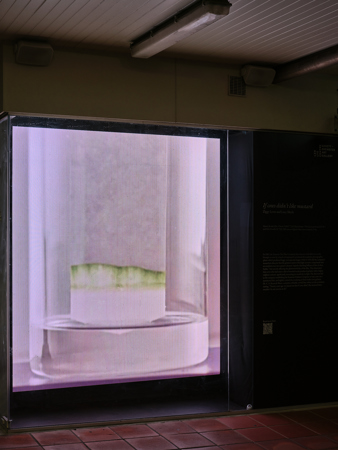
Ziggy Lever and Lucy Meyle, If cows didn’t like mustard, 2026, 16mm Kodak film: Vision 3 200T 7213; Ektachrome 7294 (cross-processed ECN-2 and E6); Double-X 7222. HD scan to digital video, stereo sound, 15:56. Courtesy of the artists.
Photo: Samuel Hartnett.Ziggy Lever and Lucy Meyle, If cows didn’t like mustard, 2026, 16mm Kodak film: Vision 3 200T 7213; Ektachrome 7294 (cross-processed ECN-2 and E6); Double-X 7222. HD scan to digital video, stereo sound, 15:56. Courtesy of the artists.
Photo: Samuel Hartnett. -

Ziggy Lever and Lucy Meyle, If cows didn’t like mustard, 2026, 16mm Kodak film: Vision 3 200T 7213; Ektachrome 7294 (cross-processed ECN-2 and E6); Double-X 7222. HD scan to digital video, stereo sound, 15:56. Courtesy of the artists.
Photo: Samuel Hartnett.Ziggy Lever and Lucy Meyle, If cows didn’t like mustard, 2026, 16mm Kodak film: Vision 3 200T 7213; Ektachrome 7294 (cross-processed ECN-2 and E6); Double-X 7222. HD scan to digital video, stereo sound, 15:56. Courtesy of the artists.
Photo: Samuel Hartnett. -

Ziggy Lever and Lucy Meyle, If cows didn’t like mustard, 2026, 16mm Kodak film: Vision 3 200T 7213; Ektachrome 7294 (cross-processed ECN-2 and E6); Double-X 7222. HD scan to digital video, stereo sound, 15:56. Courtesy of the artists.
Photo: Samuel Hartnett.Ziggy Lever and Lucy Meyle, If cows didn’t like mustard, 2026, 16mm Kodak film: Vision 3 200T 7213; Ektachrome 7294 (cross-processed ECN-2 and E6); Double-X 7222. HD scan to digital video, stereo sound, 15:56. Courtesy of the artists.
Photo: Samuel Hartnett. -

Ziggy Lever and Lucy Meyle, If cows didn’t like mustard, 2026, 16mm Kodak film: Vision 3 200T 7213; Ektachrome 7294 (cross-processed ECN-2 and E6); Double-X 7222. HD scan to digital video, stereo sound, 15:56. Courtesy of the artists.
Photo: Samuel Hartnett.Ziggy Lever and Lucy Meyle, If cows didn’t like mustard, 2026, 16mm Kodak film: Vision 3 200T 7213; Ektachrome 7294 (cross-processed ECN-2 and E6); Double-X 7222. HD scan to digital video, stereo sound, 15:56. Courtesy of the artists.
Photo: Samuel Hartnett. -

Ziggy Lever and Lucy Meyle, If cows didn’t like mustard, 2026, 16mm Kodak film: Vision 3 200T 7213; Ektachrome 7294 (cross-processed ECN-2 and E6); Double-X 7222. HD scan to digital video, stereo sound, 15:56. Courtesy of the artists.
Photo: Samuel Hartnett.Ziggy Lever and Lucy Meyle, If cows didn’t like mustard, 2026, 16mm Kodak film: Vision 3 200T 7213; Ektachrome 7294 (cross-processed ECN-2 and E6); Double-X 7222. HD scan to digital video, stereo sound, 15:56. Courtesy of the artists.
Photo: Samuel Hartnett. -

Ziggy Lever and Lucy Meyle, If cows didn’t like mustard, 2026, 16mm Kodak film: Vision 3 200T 7213; Ektachrome 7294 (cross-processed ECN-2 and E6); Double-X 7222. HD scan to digital video, stereo sound, 15:56. Courtesy of the artists.
Photo: Samuel Hartnett.Ziggy Lever and Lucy Meyle, If cows didn’t like mustard, 2026, 16mm Kodak film: Vision 3 200T 7213; Ektachrome 7294 (cross-processed ECN-2 and E6); Double-X 7222. HD scan to digital video, stereo sound, 15:56. Courtesy of the artists.
Photo: Samuel Hartnett.
Opening Day Programme:
Join Debra Bustin, Ziggy Lever and Lucy Meyle alongside exhibition curators Simon Gennard and Taarati Taiaroa for a tour of the exhibition Pause, act, void, event. Together, they’ll reflect on beloved works from the Govett-Brewster collection, as well as projects newly realised for the exhibition.
Bustin will share insights into the process of revisiting her site-specific work first realised in 1982. Upon its first public appearance in four decades, and here newly expanded far beyond its original form, hear Bustin reflect on a work that links generations, and offers an affirmation of creative potential, and the continuous process of composition, decomposition and recomposition that propels all life.
Ziggy Lever and Lucy Meyle will reflect on their newly commissioned project for the Open Window. The work departs from an 1882 event in which a batch of silver-gelatin coated glass plates—unknowingly incorporated with gelatin from cows fed on a diet rich in mustard plants—nearly destroyed the Eastman Dry Plate Company (later known as Kodak). Experimenting with the materiality of film—and the grains, pixels and particles that comprise its substance—the work considers the competing agency of humans, plants, animals and technology within the production of images and meaning.