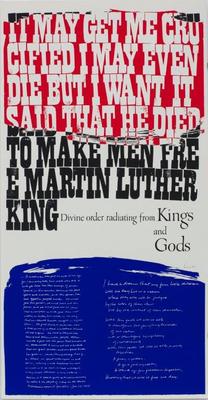
moonflowers
-
Corita Kent
b.1918
d.1986
Title
moonflowers
Details
| Production Date | 1969 |
|---|---|
| Collection(s) | Collection Govett-Brewster Art Gallery, New Plymouth. Purchased with funds gifted by the Chartwell Trust |
| Accession Number | 2016/8 |
| Media | Serigraph |
| Measurements | Framed: 670 x 390mm; Unframed: 586 x 306mm |
About
I waenga i te tau 1936 ki te tau 1968, he mema a Corita Kent o te kāhui Sisters of the Immaculate Heart of Mary, i te tāone nui o Ngā Anahera. He kāhui whakaahu whakamua, arā he aro ki te whakarato i te hapori i te aranga o ngā porotū i waenga i te porihanga o Amerika, i te wā o te whakahōunga o te hāhi Kātorika, ka whakawhanake a Kent i tāna tikanga perehi motuhake.
Huhua noa atu ngā kātū pūtake i roto i ngā mahi a Kent, he tapu, he kangakanga hoki: he kupu waiata, he kupu whakatairanga, he ata tohu, he tuhi hei tohu hei whakahau hoki. Ka aro pū tōna reo auaha ki te āhua, ki te manawataki me te hanganga o ngā pūreta – ko tana whakamātau i te whakaoho me te roroha o ngā pūreta – me tana whakahōu i ngā āhua e rērere haere ana i te ao pāpāho rongonui.
Ahakoa tana whakahē i ngā hōngere toi tuku iho, he rite tonu te whakahōu i ngā mahi a Kent, me te aha i māmā tonu ngā utu i te wā hoko. I whakatinana hoki ia ngā huihuinga nui i te taha o hāna tauira, o hōna hoa Tuāhine, me te hapori i manawanuitia e ia. I whakatairanga hāna mahi i ngā mahi nunui ki te whakaara i ngā tikanga tangata, ki te porotū atu i te whakaeke a Amerika i Witināma me te whakamānawa i te hinganga o ngā rangatira nui pērā i a Martin Luther King Jr. rāua ko John F. Kennedy. I aro te wairua me te auahatanga o Kent ki te aroha o te tangata ki te ao mā te reo e hāngai ana ki te uki hōu, me ngā pātai tōrangapū kaha o tōna wā.
—
Between 1936 and 1968, Corita Kent was a member of the Sisters of the Immaculate Heart of Mary, in Los Angeles. A progressive order, with a commitment to community service during a period of radical upheaval in American society, and reform within the Catholic church, Kent here developed her distinctive printmaking practice.
In her work, Kent drew upon a multitude of sources, both sacred and profane: song lyrics, advertising slogans and branding iconography, scripture and sermons. Her graphic language involved close attention to the form, rhythm and structure of letterforms—and experiments in how these might be made elastic and lively—as well as recontextualising imagery circulating in popular media.
Rejecting traditional art world distribution channels, Kent’s works were produced in multiples, and often sold at an affordable price. As well, she realised large-scale events in collaboration with her students, Sisters, and the community she served. She produced work in service of the civil rights movement, and in protest against the United States’ invasion of Vietnam, and to honour assassinated political figures including Martin Luther King Jr. and John F. Kennedy. Kent’s spirituality, and her artistic output, was oriented towards a humanistic commitment to the world, articulated through a language relevant to contemporary people, and thoroughly engaged with urgent political questions of her time.
— Simon Gennard, 2026